



The Compelete Technical Guide to Truck Scales

Truck scales-also known as weighbridges-serve as the backbone of industrial weight management across logistics, mining, agriculture, waste management, and commercial trade. Their primary purpose is to measure the gross, net, and tare weight of heavy trucks with high accuracy and reliability. Behind what looks like a simple weighing platform lies a deeply engineered system designed to withstand vibration, shock loading, environmental exposure, temperature variations, heavy traffic, and continuous 24/7 operation.
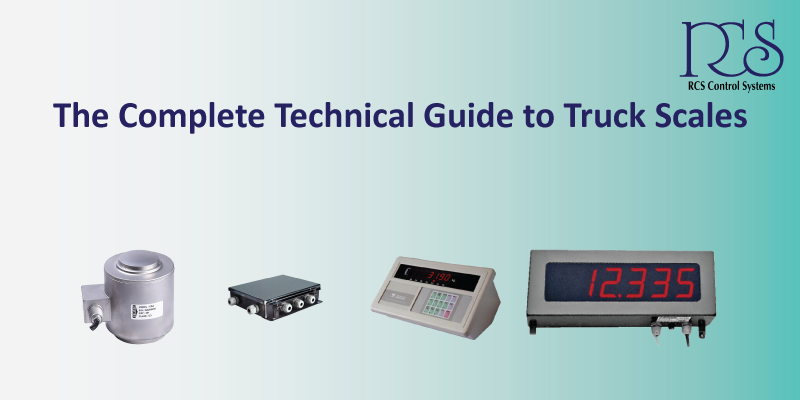
A truck scale is fundamentally a combination of four core components: load cells, a junction box, a digital indicator, and an outdoor scoreboard. Together, they form an integrated measurement ecosystem capable of delivering stable, precise, and repeatable results in environments that challenge electronic hardware every day.
Components of a Truck Scale
At the heart of every truck scale is the load cell, a precision transducer that converts mechanical force into electrical signals. The two common architectures, compression load cells and ball-and-cap designs, impact stability, temperature tolerance, lateral movement control, and long-term drift. These signals travel into the junction box, the hidden signal-management hub. Inside, the box balances the incoming signals, filters noise, protects against surges, and outputs a unified, stable measurement stream.
Once balanced, the weight indicator processes the signal, performing analog-to-digital conversion, filtering vibration, stabilizing readings, managing calibrations, storing data, and transmitting information to external systems. The scoreboard then displays the weight in large, high-brightness digits for drivers and operators, increasing efficiency and reducing human error.
How a Truck Scale Works
A truck enters the platform. The load cells detect the force applied by the vehicle. The signals merge inside the junction box and are forwarded to the digital indicator. The indicator calculates, stabilizes, and displays the final weight. From there, the measurement can be printed, logged, or transmitted to warehouse management systems. The accuracy of this workflow depends on proper load distribution, clean electrical connections, high-quality components, and well-configured electronics.
Structural Types
Truck scales are typically built in two structural forms. Pit-type installations place the weighing deck flush with the ground, making them ideal for tight spaces or sites with limited ramp length. Pitless installations elevate the deck on foundations, offering easier maintenance and improved drainage. The choice depends on space, traffic volume, soil conditions, and operational needs.
Engineering Considerations
Selecting the right truck scale requires evaluating load-cell IP rating, environmental resistance, cable quality, deck material, traffic frequency, operating temperature, expected vehicle movement, and communication needs. Wet or corrosive environments demand IP68-rated load cells, while sites with constant vibration benefit from ball-and-cap technologies. Long-term industrial reliability also depends on junction-box balancing quality and the indicator’s ability to filter electrical noise.
PACKAGE OVERVIEW
The Blue Package is engineered for environments where trucks experience lateral movement, uneven loading, or abrupt braking on the platform. Its Zemic HM9B ball-and-cap load cell allows controlled micro‑movement, significantly improving stability under dynamic loading conditions. The system is completed with the Yaohua JHX junction box, the reliable A9 indicator, and the YHL‑3 scoreboard. It is ideal for active loading yards, high-traffic logistic hubs, and facilities where vibration is common.
The Bronze Package is a cost-effective industrial solution designed for operations seeking reliable performance without high investment. It uses the Zemic HM14H load cell for stable compression weighing under general conditions. The Yaohua JHX junction box manages signal balancing, while the Yaohua A9 indicator delivers dependable digital processing. The YHL‑3 scoreboard provides clear external visibility. This package suits warehouses, construction sites, and low-to-medium traffic logistics centers.
The Silver Package is a professional-grade industrial weighing system built for precision and stable performance. It features Celltec CSG load cells paired with the Zemic JB06 junction box for refined signal integrity. The Vishay VT‑300 indicator offers advanced digital processing, while the VTRD10 scoreboard provides strong outdoor readability. This configuration suits production plants, commercial weigh stations, and freight terminals needing enhanced accuracy and robustness.
The Gold Package represents the highest level of durability and performance. It uses Celltec CSA load cells with an IP68 protection rating, making them suitable for mud, moisture, extreme weather, and continuous heavy-duty industrial use. The system integrates the Zemic JB06 junction box, the Vishay VT‑300 indicator, and the VTRD10 scoreboard, creating a platform ideal for mining, steel manufacturing, cement plants, and 24/7 high-load operations. The Gold Package is engineered for environments where precision and resilience are mission-critical.